Showing posts with label essay. Show all posts

Thursday, April 24, 2014

Essay/Review on short film Jasper Morello

Written by Jodie Becker

ACM132 – Introduction to Animation


The Mysterious Geographic Explorations of Jasper Morello – The First Voyage


The Mysterious Geographic Explorations of Jasper Morello (2005) is an Australian film directed and co-written by Anthony Lucas. It is has a long list of awards and was nominated for an academy award.

This movie is classified in a genre that became popular in the 90’s known as Steampunk - A fiction genre set in Englands Victorian era, where steam power is the prominent technology in the 19th century. However this particular film is set in the year 1276 and gives a look at an alternate world for the human race. As it is a fantasy genre there are also many fictional technologies that are not based on history, the past and present become mixed together to create all new machines. There are floating islands, iron airships and strange creatures that make up the curious world of this film.

The story follows the character Jasper Morello, a disgraced navigator who is haunted by a fatal mistake he made on his last expedition. He nervously sets out on a new voyage but vows it will be his last before he and his wife can settle down and start a family. Their home city, Gothia is currently being ravaged by a Plague and in their travels they are accompanied by a scientist searching for a cure. Jasper worries about his wife back home when he notices she is sick over a video-phone conversation. When the ship is thrown off course, they discover an abandoned ship they are forced to use when their own becomes damaged. Flying in uncharted air, the crew discovers a monster that holds a cure for the disease. Jasper is torn between the need to bring the cure to his wife and sacrificing the lives of his ship-mates.

All of the characters in this film are silhouettes. This animation style has its origins from wayang, the Indonesian shadow puppets which have been around for 300 years. The film is overall very dark and gothic due to the monochrome scheme that is also common in other silhouette films. Color has been used sparingly and only highlights the more dramatic details such as the illness that kills people that appears as a bright orange lava substance.

Traditionally silhouette animation was made using stop motion techniques, the first full length film made with this method was The Adventures of Prince Achmed (1926) by Lotte Reiniger. However traditional cel animation is easily able to imitate the style. The anime series Revolutionary Girl Utena (1997) shows example of this modern version of the technique frequently. It is most likely that The Mysterious Geographic Explorations of Jasper Morello has been made using cel or computers for the 2D animated characters.

The backgrounds in the film are made from a combination of found objects and CGI rendering. Many objects are also silhouettes but there is enough of a balance between detailed objects and the black silhouettes that they all work together harmoniously.

The Mysterious Geographic Explorations of Jasper Morello was enjoyable to watch for both its uncommon use of animation styles and curious plot line. It’s actually rather creepy and is definitely not a story for small children as it deals with darker sides of humanity, violence and death. The plot keeps you wondering how this story is going to end. When it did come to an end I was a little disappointed because the story was left open and I personally like things to be wrapped up. But I discovered that this film is part of a series containing 4 episodes (voyages). I was left wanting more, so I will seek out the other episodes and continue to follow the adventures of Jasper Morello.


Bibliography

Wikipedia, Silhouette Animation, Wikipedia, retrieved 5th August 2009, <http://en.wikipedia.org/wiki/Silhouette_animation>

 Sandall, S, Anthony Lucas on The Mysterious Geographic Explorations of Jasper Morello, Amazon, retrieved 4th August 2009, <http://readersvoice.com/interviews/2006/January/230/>

Madman Entertainment, Gothia Gazette, Madman Entertainment, retrieved 21st July 2009, <http://www.jaspermorello.com>

Wikipedia, The Mysterious Geographic Explorations of Jasper Morello, Wikipedia, retrieved 1st August 2009, <http://en.wikipedia.org/wiki/The_Mysterious_Geographic_Explorations_of_Jasper_Morello>

Foster, M,  Animated Shorts - The Mysterious Geographic Explorations of Jasper , Google, retrieved 6th August 2009, <http://www.fosteronfilm.com/shorts/jaspermorello.htm>

Saturday, March 22, 2014

Hiroshi Sugimoto Essay

Essay by Jodie Becker


HIROSHI SUGIMOTO

Hiroshi Sugimoto was born in Tokyo, Japan in 1948. He finished university in 1970, his initial studies were Politics/Socialogy and not photography related at all. He later retrained himself with a BFA in Fine Arts at the Art Center College of Art and Design in Los Angeles, California, which he graduated from in 1974. He then moved to New York, however he spreads himself between American and Japan, which is reflected in his photographs.

Many of Sugimoto’s photography themes are often related to the flow of time, life and death, surrealism and fascination with science/math. He uses a large format camera and has an exceptional technical ability but is also admired for the philosophical connections that form the conceptual ideas in his work. Most often he does photographic series. He often likes to question ones sense of reality, especially when it is commonly perceived that a photograph only captures the truth. Sugimoto never photographs living people, his subjects are statues, models, landscape, sculpture and architecture. He prefers to shoot with natural lighting and will avoid using studio lighting where possible, he also prefers his exhibitions to be bathed in natural light and does not concern himself with the deterioration of the images as he believes this is a natural flow of life.


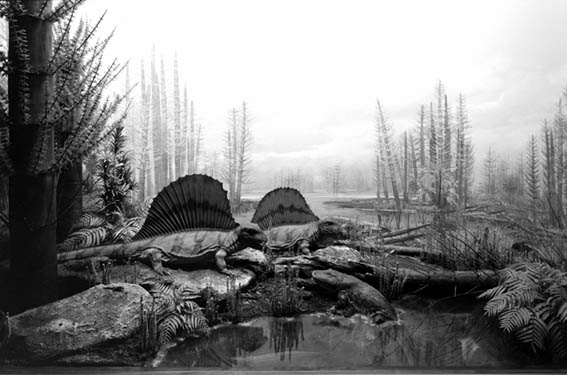
Permian Land, 2004

DIORAMAS
When visiting the American Musuem of Natural History in New York, Sugimoto observed that the stuffed animals against painted backgrounds looked tragically fake, but when he squinted one eye, the perspective would vanish and it looked more realistic. He thought that perhaps this is how the camera would see the image and set about making the Diorama series. At a first glance the images do look real but when you notice creatures such as dinosaurs, you realise they do not exist in the world today and therefore the image cannot be a real living creature that has been captured by the camera.


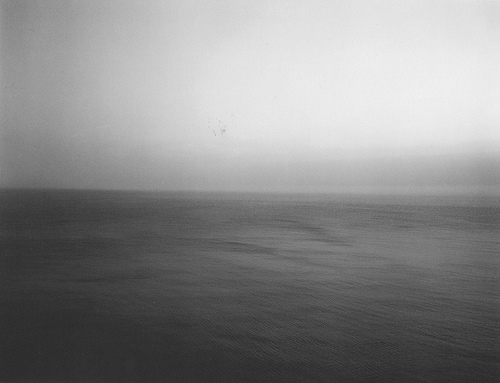
Sea of Japan, Hokkaido, 1986

SEASCAPES
At a first glance, the series of Seascapes look quite simple. Calm compositions divided equally between the water and sky. But the philosophy behind them is wonderfully thought out.

“Water and air. So very commonplace are these substances, they hardly attract attention - and yet they vouchsafe our very existance” (Hiroshi Sugimoto)

The way each seascape has been photographed makes it ambiguous to it’s location, with only the title tying it to the place of capture. Longer shutterspeeds have been used on some of the images, which as a result have a soft ethereal quality to them, where the waves and sky have drifted together during the exposure time. While each photograph has been framed the same way, each has it’s own quality in the variation of shutterspeeds and the type of weather present at the scene.


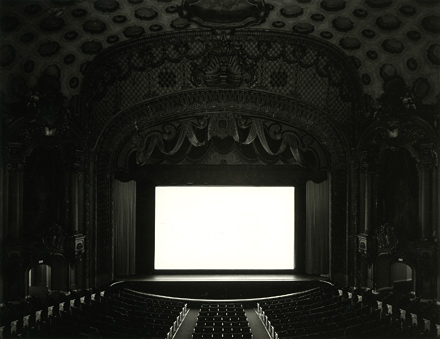
Metropolitan, 1993

THEATRES
Sugimoto had an interesting thought session that led to the question “Suppose you shoot a whole movie in a single frame?” where of course the answer is “You get a shining screen”. He took action to realise this vision and began experimenting by taking his camera to a theatre, where he set the shutter open, only to click it closed when the movie had finished. He developed the film the same night and was completely amazed by the result. He has since photographed many different theatres in this fashion, being lit by only the light of the movie itself which becomes an indistinguishable white screen but therefore condensing the whole movie to one frame, collapsing time into what seems like a single moment. The theatres which are usually filled with people during a movie screening, look quite eerie as they are empty in Sugimotos photographs.


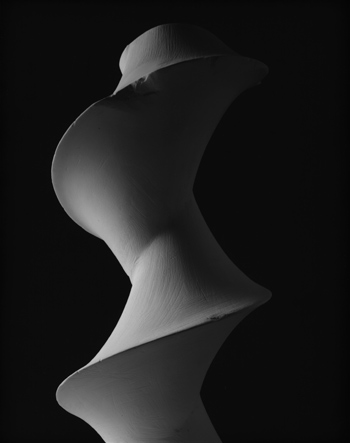
Mathematical Form 0003, 2004.
Dini's surface: a surface of contant negative curvature obtained by twisting a pseudosphere.

MATHEMATICAL FORMS
Sugimoto has a fascination in mathematical sculptures and the beauty they create without being intentional pieces of art work. “Art resides even in things with no artistic intentions” (Hiroshi Sugimoto). The objects known as “stereometric exemplars” were used as teaching aids to demonstrate trigonometric functions to students. They have been photographed in a way that they appear as abstract statuesque monuments against a black background, giving the viewer no clue as to the real size of the object and therefore perceived as being very large as they dominate the frame.


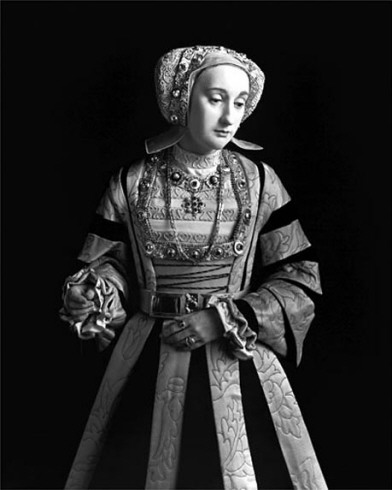
Anne of Cleves, 1999

PORTRAITS
The famous wax museum Madame Tussuads has many historical figures that have been made with only renaissance paintings as reference, as photography did not exist in their era. Sugimoto has then photographed these figures with renaissance style lighting to immitate the paintings, yet the photographs turn out looking as though a real person could be standing in front of the camera. Many levels of different art mediums imitating each other makes us question the sense of reality in the photographs. Sugimoto himself has said “If this photograph no appears lifelike to you, you had better reconsider what it means to be alive here and now.”


Many of Sugimoto’s themes challenge your perception of reality in his photographs. The ideas of art and science are being intermingled into one. His beautiful execution of the images also indicates his understanding of the interrelation between science and art and not just his ability to pose questions about it. There’s a dreamy quality in his photographs that also demands us to acknowledge the here and now. The metaphysical philosophy that drives his choice of subject matter creates a story behind each image that makes the viewer question their perception of time, space and self. These questions and themes are very evident in his series Dioramas, Seascapes, Mathematical Forms, Portraits and Theatres.


REFERENCES

Sugimoto Hiroshi, Portfolio, retrieved 20 April 2011, <http://www.sugimotohiroshi.com/>

ARTINFO, Lightning Fields, retrieved 20 April 2011,

The Coveted, Trip to the museum: Contemporary Japanese Fashion, retrieved 20 April 2011, <http://the-coveted.com/blog/2007/11/28/trip-to-the-museum-contemporary-japanese-fashion/>

Art Knowledge News, Lucerne Museum of Art displays a Hiroshi Sugimoto Retrospective, retrieved 20 April 2011,


Heike Helfert, Sugimoto Hiroshi Theatres, retrieved 20 April 2011, <http://www.medienkunstnetz.de/works/theaters/>

Thomas Kellein, Hiroshi Sugimoto : Time Exposed, 1995, Thames & Hudson.

Johnny, Hiroshi Sugimoto’s Sea Scapes at the Gagosian, retrieved 20 April 2011, <http://www.spoon-tamago.com/2008/12/10/hiroshi-sugimotos-sea-scapes-at-the-gagosian/>

C4 Art Gallery, Hiroshi Sugimoto: Seascapes, retrieved 20 April 2011, <http://c4gallery.com/artist/database/hiroshi-sugimoto/seascapes/hiroshi-sugimoto-seascapes.html>


Levy Gallery, Hiroshi Sugimoto: Conceptual Forms, retrieved 20 April 2011, <http://www.levygallery.com/inventory/hiroshi_sugimoto/03.html>

Zuihitsu, Hiroshi Sugimoto at the de Young, Part I, retrieved 20 April 2011,


Wikipedia, Hiroshi Sugimoto, retrieved 5 May 2011, <http://en.wikipedia.org/wiki/Hiroshi_Sugimoto>

Monday, March 25, 2013

Tracey Moffatt - Laudanum - ACM204 ESSAY

Here's an essay on a photography series by Tracey Moffatt, that I wrote for ACM204 - one of my photography units. At a first glance I actually didn't think much of these images, until I thought about more deeply how they could all be connected to make a story. I read various reviews for clues and then let my imagination wander. I ended up liking it after studying the series.


Tracey Moffatt was born at Brisbane in 1960. She graduated with a degree in Visual Communications from the Queensland College of Art in 1982. She debuted on the Australia art scene with her first solo photography exhibition in 1989.

She is well known for her photography and short films that tell fictional stories in constructed scenery. She often plays a character in her own photographs. Two of her films (night cries and bedevil) have been selected for the Cannes Film Festival and her photography has been exhibited in museums worldwide. A recent series titled "Under the sign of Scorpio" has her impersonating famous Scorpio women.

The Laudanum series was created in 1998 yet look like the photos could have been taken 100 years ago. The whole set is presented in black and white, printed on rag paper with the photogravure etching technique. The negatives have been digitally altered to look weathered on purpose giving the impression that you are looking at a very old photograph. It draws upon the themes and imagery of German Expressionist film from the 1920's. In those harsh economic times after World War 1, the Germans could not directly compete with the higher budget films being made by Hollywood at the time and instead explored the darker sides of life with tales of sadness and betrayal, paving the way for the modern day Horror movie genre. Australia's dark history of racism and cruelty connects with the subject matter of film noir and German expressionist films that had a departure from the action and romance stories made by Americans. Despite the Laudanum set being shot in a colonial mansion in Australia, the scenes that take place could have taken place in any western country in the late 19th and early 20th century where race and class segregated people.

The first image in the 19 piece series of Laudanum shows a scene that immediatly brings the issues of class and race to mind. A maid in a completely subserviant position seems to be almost flat out on the floor before the feet of her mistress that is declining the staircase. The series of images that follow seem to be out of order but when the title of the series is taken into account, the story begins to emerge.
Laudanum was a drug made from Opium that was used in the early 20th century for a variety of ailments. It was used by women as a calmative and was known for having hallucinogenic properties. And thus, this photographic series portrays a drug induced fantasy of domination, torture and sexuality between a mistress and her servant.

Some images obscure parts of the scene or the characters faces, creating a voyeuristic feeling in the viewer. An image of a woman leaning against a wall is presented in both an oval and a keyhole. It is not clear what she is doing but the expression on her face seems wistful. It is not clear if she is one of the women from the previous picture or not, as she is wearing different clothing.

In the third image the same woman appears, dressed as the mistress thus making it more obvious who she is. Her hair is down and she seems to be undressing. The young woman behind her is naked with a blissful expression. The image of her face has been ghosted into the background that swirls and wavers, perhaps indicating that both these women are experimenting with drugs and their sexuality.

Pleasure seems to be laced with pain as the scenes become more sinister. The maid seems to be held down and tortured by her mistress. The image of the house next to this one is a juxtaposition as it seems so  peaceful compared to what is happening inside.

While the maid seems to be dominated and tortured by her mistress in previous images, she does not seem to be resisting or distressed by acts that seem cruel. It seems as if she has resigned herself to this submissive role. Even after having all her hair cut off, she still lays face down on the table, seemingly held down by nothing. Her face is never shown in these scenes, you may feel a little sorry for her but since no signs of anguish are portrayed you wonder if perhaps she enjoys it.

In fact it seems like the mistress becomes more disturbed by her acts of cruelty as she buries her face in her arms in image 10. The maid is reclined on the sofa, posed like an artistic nude. Her face is so serene that I wonder if she is dead or just sleeping. Is this perhaps why the mistress looks so distressed.
The mistress seems to further spiral into insanity and continues to torture her victim. Warped silhouettes of hands over her head, look like horns of a monster. Even the staircase and wall is warped. It's like a scene out of a horror movie.

A scene looking through the crossed bars feels like looking into a cage or dungeon. The maid is slumped against the wall but her face is obscured by the bars. The other woman seems to be leaning over a bench, her head also covered by the bars. Has this gone from an S&M fantasy to a murder? Is image 10 perhaps the end result of this power play, an accidental murder?

The final image showing the woman in her underwear crawling up the stairs brings us full circle. It parallels the first image in the series with the same location. However these scene perhaps shows us the reality of the story - a weakened woman (from illness or drug overdose) has conjured up the whole master/slave scenario in her mind. The maid was nothing more than a pillow on the floor. A menacing black cloud swirls around the floor signifying the womans delusional state of mind.

REFERENCES

http://www.eniar.org/news/moffatt.html
http://nga.gov.au/dreaming/Index.cfm?Refrnc=Ch9
http://about.nsw.gov.au/collections/doc/laudanum-9/
http://flighthotel.ca/2010/02/03/tracey-moffatt-birch-libralato-toronto/
http://en.wikipedia.org/wiki/German_expressionism
http://www.van-horn.net/tracey-moffatt
http://www.smh.com.au/news/arts/the-secret-lives-of-tracey-moffatt/2005/07/29/1122144006147.html
http://www.artnet.com/artist/11933/tracey-moffatt.html
http://www.roslynoxley9.com.au/artists/26/Tracey_Moffatt/
http://www.kaldorartprojects.org.au/education/move-moffatt.asp


Monday, August 9, 2010

ACN108 History of Interactive Entertainment - Assignment 1

WIKI


Wiki sites have become a great resource for researching topics online. They have a few pro's and con's but overall I find my experience with them to be a positive one.

There are many topics found on wiki sites that are just not covered in published books. Unlike a printed book, a wiki article is much more dynamic in it's ability to be updated quickly when the information changes. A set of Encyclopedia books is very expensive yet websites like Wikipedia are completely free and far more up to date. While libraries have closing times, the internet is available 24/7/365 and accessible from the comfort and convenience of your home. There is no need for an expansive bookshelf to hold a large collection of research books when the information can all be stored compactly at data on a computer.

The downside of Wiki's is that with multiple contributors from all walks of life, the information could be less reliable. Wiki sites are also prone to attacks of cyber vandalism, as just about anyone is allowed to register with a website and gain the ability to edit wiki entries. Moderators need to keep a watch on changes made to the site in order to maintain it as a reputable source of information. A lot of Wiki websites resource their information from Wikipedia, however if the information on Wikipedia is incorrect, then false information is being duplicated throughout the internet. There’s a saying that goes “Just because you read it on the internet, doesn’t mean it’s true”.

Personally I use websites like wowwiki.com and wowhead.com for sourcing information for World of Warcraft. There is no way you want to flip through a book to find information about a digital item when you can search quickly with keywords on a website. I also love to browse Wikipedia for information on various video games, anime, manga and bands that simply do not have any printed material available on them. In these genres, I trust the opinions of my internet peers rather than the producers of newspapers and tv shows. News writiers are forever getting their facts wrong when reporting anything to do with geek culture.


SOCIAL NETWORKING

Social networking began with the emergence of Web 2.0 technologies. The basic idea is that rather than create all the website content yourself, you create applications where others can register with the site and create their own content that they can share with others. Online communities sprung up in many different ways. Blogging, social networking, online gaming and art websites are probably the most prominent models for Web 2.0 communities. Many sites have become a hybrid of all these things in an effort to offer something for everyone and keep users feeling like they don’t need to leave the site to use a different service.

Examples of various Web 2.0 community websites:
Blogging sites: Livejournal, Wordpress, Blogger
Microblogging: Twitter, Tumblr
Social Profiles: Myspace, Facebook, Hi5
Art: Deviantart, Flickr
Games: Gaia, Neopets


While I absolutely adore blogging and update my Livejournal frequently, it saddens me to see that many people have jumped ship for websites like Facebook and Twitter. Neither of which have the same sort of insightfulness that users post in their Livejournal. Twitter is full of throwaway comments and meaningless updates as the posts are limited to only 140 characters. Facebook is much the same on an even greater level. Because Facebook encourages users to use their real name and connect with every single person they know in life, what one announces publicly to the world becomes much more of a considered matter. While announcing silly statements under the guise of an internet alias is something I think nothing of on most websites, when it comes to Facebook I feel a strangling on my freedom of speech. Knowing that relatives and work colleagues can read what you post on Facebook makes you think twice about what you are going to write, and so posts become the monotonous sea of “Oh the weather is nice today and I just ate toast”. In comparison, a personal blog locked to friends only may contain far more interesting posts such as detailed stories about a persons inner feelings, their daily frustrations at work or their great experience at a special event such as a live band.

Many sites are now trying to do and be everything in order to be the one stop shop that people visit on the internet. Facebook in particular is guilty of this and as a result the site is bloated and confusing. I’m really tech savvy and work as webdesigner and I still find Facebook very poorly organised. I’m flooded with updates from other users applications I don’t care about, so that I’ve given up on trying to keep up with the information updates from Facebook. However I feel like there is this pressure to stay updated and available in todays “online” society. If you turn off the chat features, don’t answer private messages & invites in a timely manner, some people get upset with you. I feel stressed by these expectations as I’m not a largely social person and find my energy to face the world in my own solitude. When something like using the internet becomes another extension of social time it becomes quite draining on my sanity.

Recently Blizzard Entertainment added a feature called "Real ID" which lets you keep friends list across World of Warcraft and other Battle.net games like Starcraft 2. It uses your real name and tells people what character/server/game you are playing. Especially in the case of WoW it's handy for keeping track of friends that have a lot of characters they play. However it can be a bit of a joykill for people that play on the Roleplay servers and really want to immerse themselves in fantasy. At this point in time there is no invisible mode for Real ID. So friends you've approved will always see what you're doing and be able to message you. Although I personally I find it annoying, this sort of thing is accepted by a lot of internet users as many already use chat programs like Steam to stay connected with their friends while in-game and use Facebook to interact with personal friends and family with their real name in a similar manner. However, Blizzard were going to force the implementation of Real ID into the forums for World of Warcraft and Starcraft 2, meaning users would only be able to post using their real name in an extremely public arena.. Privacy was a large concern for users, as once you have someones real name it is actually quite easy to track their phone number or where they live. Taking into consideration that people in online games can become quite aggressive or upset when another player kills them, you wouldn’t really want an online enemy knowing where you live. Reports of violence over video games are not unheard of. While the games themselves are not to blame, if a person with emotional or mental problems is aggravated while playing them, the results can lead to violence. Due to the large outcry from the Battle.net community, Blizzard withdrew their plans to force users to use their real names on the forums. The RealID online friends list still remains and while I feel it is a good feature it does need to be developed to ensure that users privacy is not compromised.

GAME-PLAY

Long before the internet and consoles, games have been interactive. In fact it’s probably video games that made single player games more prominent. In comparison board games moreso required you to have other people to play with in order to enjoy them. Playing with another person means you have to adhere to the rules in order to “play fair” but playing by yourself it’s pretty easy to cheat and win the game. I’ve cheated plenty of times while playing single card games like Solitaire, however playing Solitaires computerised counterpart keeps you honest as the program does not allow you to break the rules. It’s much more satisfying to win the game when you know you played it properly by the rules. A game should be fun but also a little challenging, so if you are cheating I suppose you aren’t really “playing the game” as such. If you are only wishing to pass the time and be entertained, it’s probably more likely someone will sit in front of the television rather than go to the effort of moving pieces around a board game. Perhaps entertainment and game-play can be separated on these grounds. Bringing us the essential core of “interactive entertainment” being some essence of game-play as it requires an effort on our part rather than just sitting back passively.

Online games are becoming more widespread as internet connectivity for game consoles is becoming a standard feature. As well as many social networking sites such as Facebook are incorporating games into their foray of applications. This expansion of gaming platforms as well as it’s ability to connect a user to all their friends/family is helping to shift the demographics of those who play video games. However it is strange that while there are many forms of games from such as gambling, board games and sports that are enjoyed by all ages, that still video games are viewed as something that only young people play.

With the proposals of the types of game-play by Roger Caillois, one could argue that we encounter games in our daily lives on a subconscious level. Games are not simply for children because we are always interacting with the world around us, facing challenges, taking chances, playing a part or losing ourselves in the thrill of something.

As I mentioned earlier, sites like Facebook make me feel very restricted, is perhaps that I am experiencing “Mimesis” and forcing myself to role play a well behaved version of myself? Or am I role playing someone I want to be when I post anonymously on sites like 4chan? Which is the real me? The one I present when attached to my real name or the one I present when behind an alias or complete anonymity. Either way, people interact with these different versions of myself and each will have different perceptions even if they encountered the same personality.

Is one experiencing “Agon” when they go for a job as they try to the beat the other applicants? Many people are competitive by nature and will find satisfaction in the smallest of triumphs over others. Something as simple as beating others over the crosswalk when crossing the road might be the motivator for some. Some even live vicariously through the victories of their sporting team over a friends. I feel that without Agon that some people would be stripped of a reason for living. It is impossible to live in our society without interacting and competing with others.

REFERENCES

Game Politics, BREAKING: Judge Rejects Video Game Murder Defense for Halo 3 Teen, Retrieved 9th August 2010,
http://www.gamepolitics.com/2009/01/12/breaking-judge-rejects-video-game-murder-defense-halo-3-teen

NineMSN, Police investigate 'World of Warcraft' murder, retrieved 9th August 2010,
http://news.ninemsn.com.au/technology/975707/police-investigate-world-of-warcraft-murder

Youtube, Art & Technology 9.1 Caillois & Video Games, retrieved 9th August 2010,
http://www.youtube.com/watch?v=TWzxpbr8_-A

Turney, Drew, ‘Got Game?’, Desktop, no. 236, 2008, pp. 50-52.

The Economist, Serious Fun, retrieved 16 August 2009, http://www.economist.com/sciencetechnology/tq/displayStory.cfm?story_id=13174355

Neoseeker, Blizzard responds to Real ID backlash, retrieved 9th August 2010,
http://www.neoseeker.com/news/14312-blizzard-responds-to-real-id-backlash/